×
Industrial automation is moving toward equipment that must do more than repeat a programmed movement. Modern production systems need to accelerate quickly, stop accurately, handle changing payloads, fit into smaller workspaces and operate for long periods with controlled maintenance requirements. These demands have made structural mass an important design variable, especially in moving members such as robotic arms, gantries, pick-and-place beams and inspection frames.
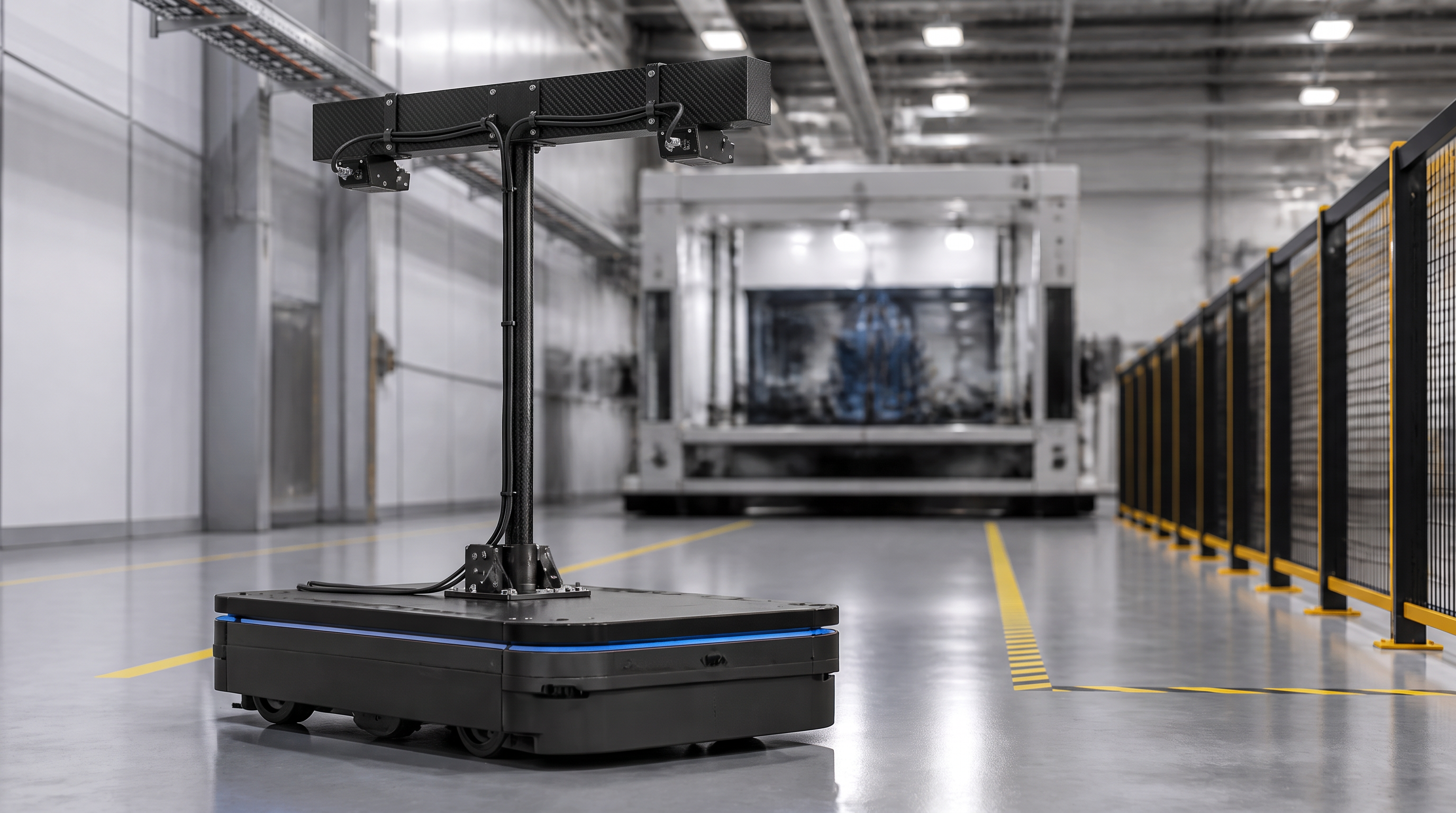
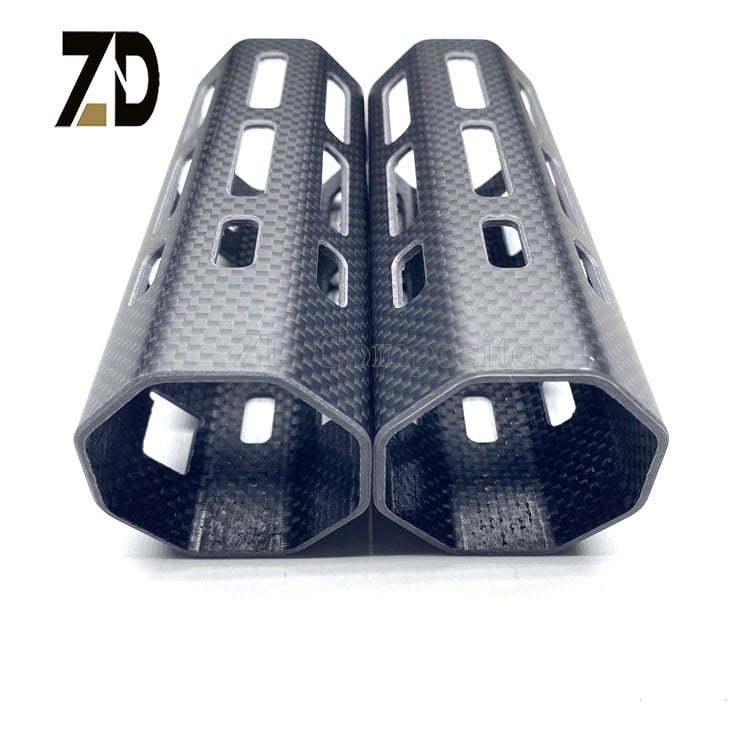
For this reason, engineers are increasingly evaluating carbon fiber profiles for robotics. A carbon fiber tube, square tube, rectangular tube or custom pultruded profile can combine low mass with useful longitudinal stiffness. When the section is correctly matched to the load path and connected with suitable hardware, it can help an automation system move its working structure more efficiently without simply increasing motor size.
The opportunity is not to replace every metal part with carbon fiber. The better approach is to assign each material a clear role. Carbon fiber can provide the lightweight beam, arm or rail; aluminum or steel can provide a bearing seat, gearbox interface or highly concentrated connection; and machined inserts can distribute fastener loads. This hybrid design logic is particularly relevant to robotics manufacturers and automation integrators developing repeatable OEM equipment.
A robot does not move only its payload. It also moves its own arm sections, brackets, cable carriers, sensor mounts and end-of-arm tooling. When a moving member becomes lighter, the drive system may have less structural mass to accelerate and decelerate. The practical result depends on the complete mechanism, but the design team can gain more freedom to balance speed, payload, reach, motor selection and energy use.
Mass at the end of a robotic arm is especially important because it affects the joint through the entire upstream mechanism. A heavy distal component can increase the effort required at the base joint and influence vibration during fast direction changes. A lightweight carbon fiber arm section or end-effector support may therefore be useful when the application requires long reach, rapid indexing or frequent start-and-stop motion.
Stiffness must remain part of the same discussion. A structure that is light but too flexible can create positioning error, vibration, settling time or poor process repeatability. Carbon fiber is attractive because its fiber architecture can be designed to place stiffness along the dominant load direction. The correct result is not simply the lowest mass; it is an appropriate relationship between mass, bending stiffness, torsional behaviour, damping, joint design and control requirements.
A carbon fiber robotic arm may use a tube or profile as a main link, secondary link, support boom or internal structural member. The tube form is efficient when a long member must resist bending while keeping material away from the neutral axis. It also creates a protected internal space that may be useful for routing cables, pneumatic lines or sensor wiring, subject to the required electrical and service clearances.
The most suitable cross-section depends on how the arm is loaded and how it must connect to the rest of the robot.
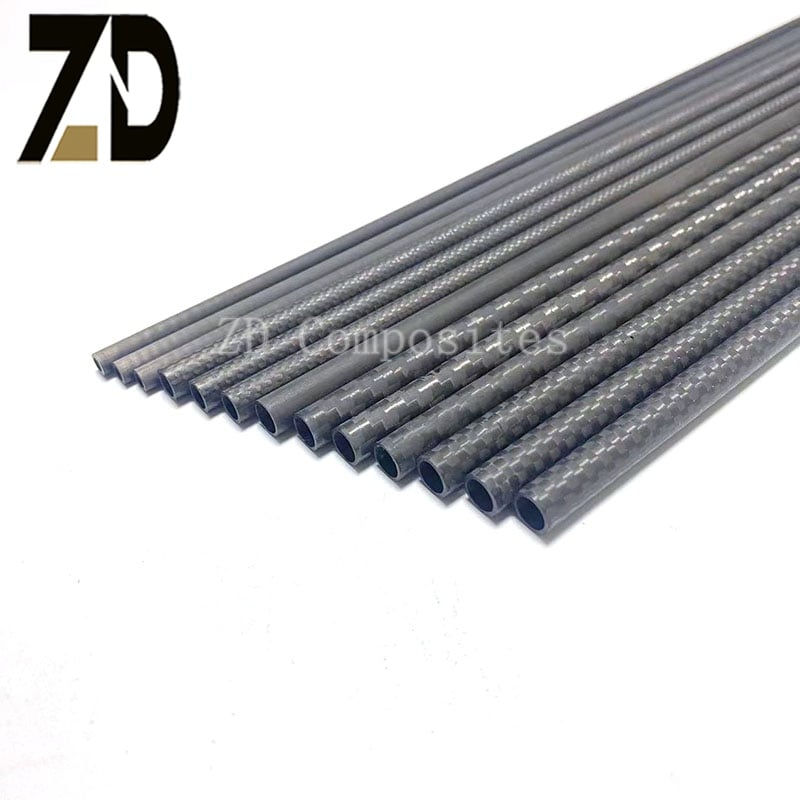
Round tubes remain a practical choice for booms, shafts, sensor supports and clamp-based mechanisms. Their continuous outer surface is useful when the tube must be supported by circular clamps or rotated within a bearing-related assembly. A round section can also simplify the design of certain telescoping or adjustable structures.
The limitation is at the interface. A round tube does not naturally provide a flat anti-rotation face, so the connector may need a split clamp, keyed insert, bonded fitting or machined transition block. The joint must distribute the load without crushing the composite wall.
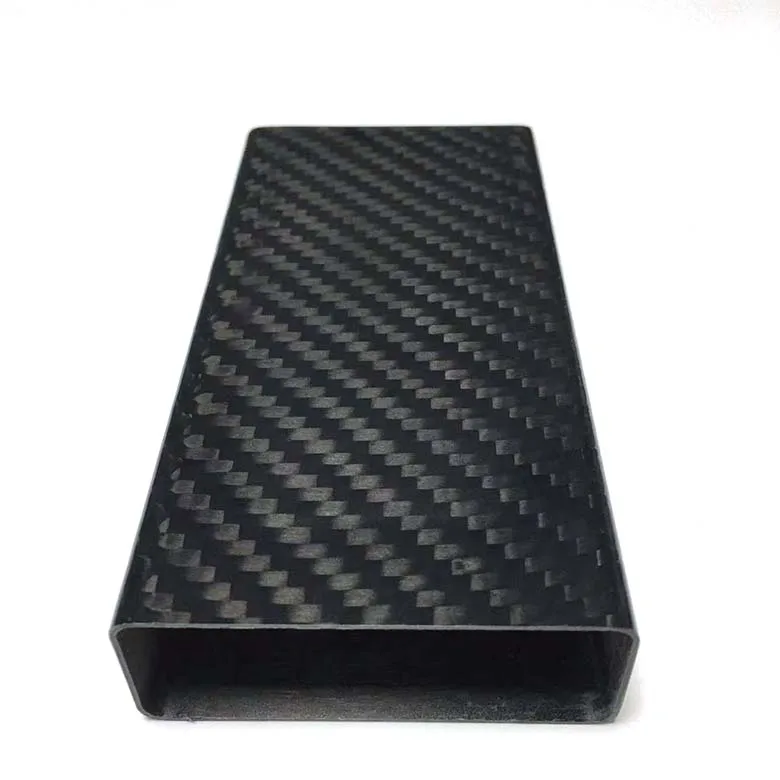
A carbon fiber square tube or rectangular tube offers defined mounting faces. These faces can simplify the attachment of motor plates, cable guides, sensor brackets, covers and end-effector adapters. The profile can also help control orientation when it enters a matching socket or keyed connector.
Square and rectangular sections are useful when assembly repeatability is more important than free rotation. They can support a modular frame in which different tools, trays or sensor packages are installed against predictable reference planes. The corners still require careful design. External corner radii, wall thickness, local reinforcement and clamping pressure should be specified in the drawing rather than left to assumption.
Pick-and-place equipment repeatedly moves a gripper, vacuum tool or custom end effector between defined locations. Its performance is influenced by payload, reach, acceleration, structural stiffness, drive selection and control tuning. A long moving beam or arm made from a suitable pultruded carbon fiber profile can reduce the mass that the drive system must carry through each cycle.
For this application, the profile should be considered as part of a dynamic assembly. The design team should evaluate the arm length, tool mass, centre of gravity, joint spacing, expected acceleration, cable routing and allowable settling time. A lightweight tube does not automatically improve the system if the mounting brackets are flexible or if the connection introduces excessive play.
A pultruded carbon fiber tube can be considered for a constant-section arm or beam where the main loads are predictable and aligned largely along the length. For joints that introduce significant transverse, torsional or crushing loads, the tube may require bonded inserts, internal sleeves, external doublers or a transition fitting. These local details often determine whether the part performs reliably in production.
Collaborative robots are designed to work in closer proximity to people and are commonly used for tasks such as light assembly, machine tending, inspection, packaging and material handling. The structural design still needs to balance reach, payload, safety-related limits, surface protection and repeatable motion.
Carbon fiber can contribute to a lighter arm architecture, but safety cannot be reduced to material selection. A collaborative robot requires a complete assessment of motion, control, guarding, pinch points, surface condition and the relevant machine safety requirements. The role of a carbon fiber component is to support the mechanical design; it is not a substitute for system-level validation.
For cobot manufacturers, a carbon fiber tube may serve as an arm shell support, internal beam, sensor boom or lightweight tool carrier. A square or rectangular profile can be useful when cable channels, covers or modular brackets must be indexed along flat faces. A round profile may be more suitable where the external envelope is cylindrical or where an existing clamp architecture is already established.
Automated guided vehicles and autonomous mobile robots carry batteries, sensors, control hardware and sometimes payload modules through warehouses, factories and logistics areas. Their moving frame must remain light enough to preserve operating efficiency while providing stable mounting for lidar, cameras, bumpers, trays and communication equipment.
Carbon fiber profiles can be used in selected upper frames, sensor masts, payload supports, protective structures and removable modules. The material is particularly relevant when a long sensor boom or elevated frame must remain stiff without adding unnecessary mass above the vehicle's centre of gravity.
The design priorities are different from those of a fast robotic arm. Mobile platforms experience floor vibration, impacts at protective structures, repeated docking loads, transport handling and exposure to dust or moisture. Engineers should therefore review local impact resistance, fastener pull-out, edge protection and repairability. A mixed-material structure may be the most practical solution: carbon fiber for the long lightweight member, aluminum or steel for sacrificial guards and concentrated mounting points.
Vision systems and inspection tools depend on stable positioning. Cameras, lighting assemblies, laser sensors and measurement heads may be mounted on frames that extend over a conveyor, machine tool or production station. Even a small structural movement can influence image alignment, focus, calibration or measurement repeatability.
A carbon fiber robot beam or sensor support can provide a lightweight structure with useful stiffness and low thermal expansion characteristics. This can be valuable when a long support must remain dimensionally stable as the operating environment changes. However, the actual thermal behaviour depends on fiber direction, laminate architecture, resin system, joints and the way the structure is constrained. A product should not be described as dimensionally invariant without application-specific analysis.
For camera and metrology structures, the interface is as important as the profile. The mounting surface should be stable, the fasteners should not introduce local damage, and the design should allow calibration or replacement without disturbing the entire frame. Carbon fiber is electrically conductive, so cable routing, grounding, insulation and electromagnetic compatibility should also be reviewed when sensitive electronics are attached directly to the structure.
The end effector is the point where the robot interacts with the product. It may include grippers, suction cups, welding tools, cutters, inspection heads, fixtures or changeable tooling. Although the end effector is often smaller than the robot arm, its mass directly affects the moving system and its geometry determines how loads enter the wrist interface.
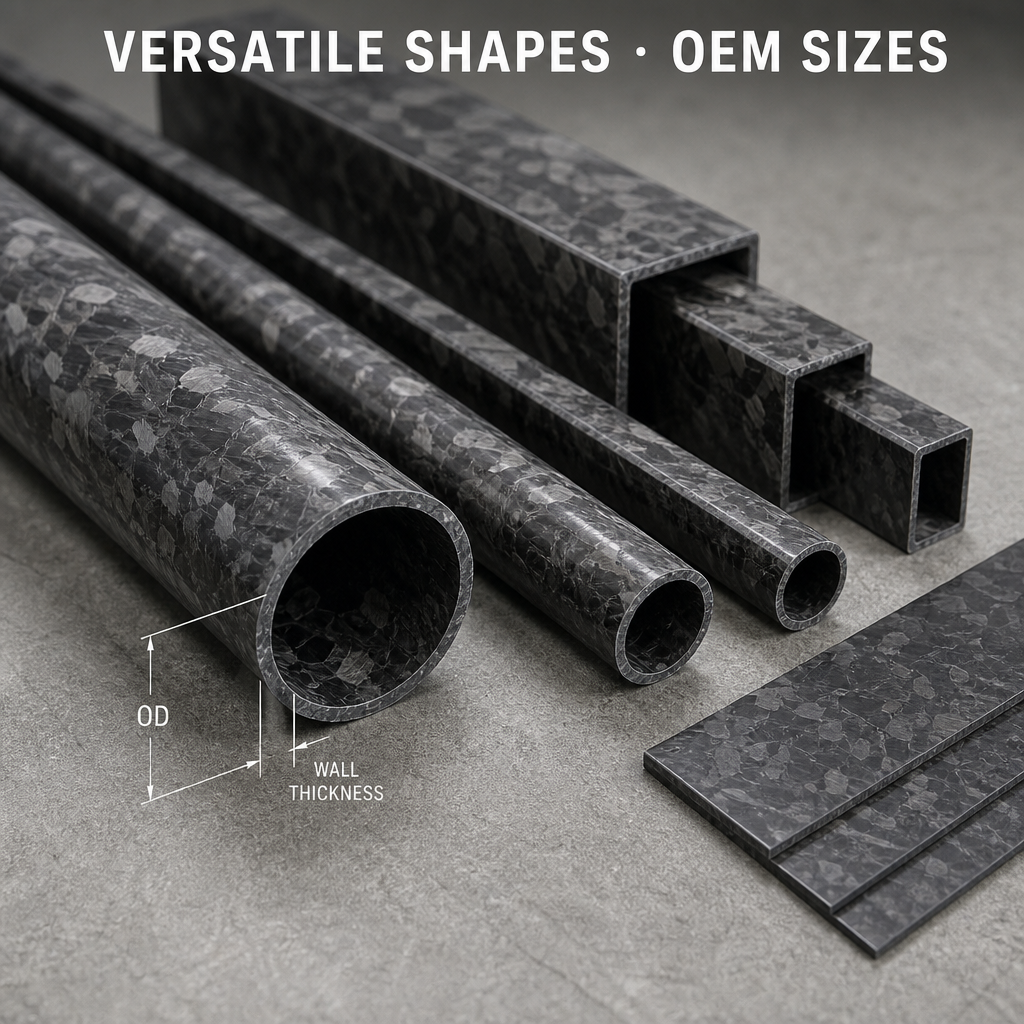
Carbon fiber plates and profiles can work together in a modular tool. A carbon fiber plate can provide a flat mounting surface, while a square tube or rectangular profile can form a stiff perimeter or stand-off frame. Round tubes may be used for lightweight booms, tool supports or protective loops where a curved form is preferred. The three forms should not be selected by appearance alone; each should be matched to the required bending, torsion, impact and connection conditions.
A professional end-effector design normally includes local metal interfaces. Threaded inserts, adapter plates, dowel features, bearing seats and replaceable wear parts can be machined from metal and connected to the composite structure. The composite section should spread the load around these interfaces rather than relying on a bolt bearing directly against an unsupported thin wall.
The manufacturing route should follow the application rather than the other way around.
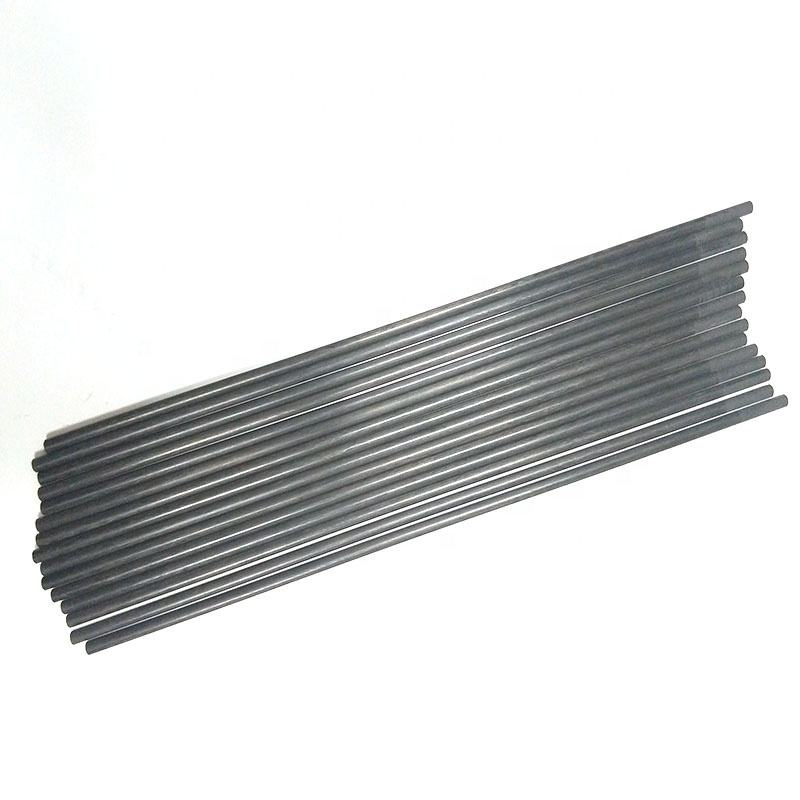
Pultrusion is well suited to continuous tubes, square tubes, rectangular tubes, rods, strips and other profiles with a stable cross-section. The process can provide repeatable dimensions and efficient production for long members. It is a practical option for straight robot links, guide supports, sensor masts, cross-members and automation frames where the dominant load direction is known.
A pultruded profile may be supplied as a continuous length and then cut, drilled, bonded or finished for the final assembly. The production drawing should define allowable tolerances, cut-end treatment, hole locations, surface requirements and any required local reinforcement.
Roll-wrapped and laminated constructions offer more flexibility in arranging longitudinal, transverse and angled reinforcement. They may be considered when the part must manage stronger torsional loads, multi-directional impacts, complex tapers or demanding crush resistance. The trade-offs can include more tooling steps, higher process complexity and a different cost structure.
Many automation systems benefit from a hybrid approach. A pultruded carbon fiber tube can provide the long lightweight beam, while a machined aluminum interface can carry bearings, gearboxes or threaded fasteners. A carbon fiber plate can close the frame or support a sensor, and a molded or machined part can protect a local joint.
This approach is more realistic than forcing one material or one process to perform every function. It also creates a clearer path for repair, inspection and future product revisions.
Straight carbon fiber profiles are usually not the most difficult part of a robotic component. The joint is where loads become concentrated and where different materials meet. Common interfaces include clamps, bonded sleeves, end plugs, flange adapters, plates, hinge blocks, bearing housings and bolted brackets.
Before production, the design team should examine:
A supplier who reviews the tube but ignores the joint is not reviewing the complete application. For OEM programs, drawings should show the interface geometry, fastener pattern, allowable clamping pressure, insert details and any bonding or sealing requirements.
Robotics and automation equipment may operate near motors, drives, heaters, coolants, cleaning agents, dust and repeated temperature changes. The carbon fiber profile must therefore be selected with the environment in mind.
Carbon fiber composites do not rust like ordinary steel, but the resin system, coating, cut edge and metal interface still influence durability. Cut ends should be finished or sealed where fiber exposure, moisture ingress or handling contact is a concern. In outdoor or washdown environments, the complete joint should be designed for drainage, sealing and inspection.
Carbon fiber is also electrically conductive. It should not be treated as an automatic electrical insulator. Designers may need insulating layers, controlled grounding, clearance around antennas and a review of electromagnetic compatibility. These requirements are especially important when the profile carries cameras, encoders, wireless equipment or control wiring.
A useful RFQ should provide enough information for the supplier to evaluate the actual load path. Include:
If the load case is incomplete, the correct next step is not an invented performance guarantee. The supplier should identify the missing information and recommend a prototype or joint test plan. For a flight-critical, safety-related or high-speed automation structure, final validation belongs to the responsible engineering team.
The industrial robotics sector continues to operate at a large global scale. The International Federation of Robotics reported in its World Robotics 2025 industrial robots summary that 542,076 industrial robots were installed worldwide in 2024, while the global operational stock reached 4,663,773 units. These figures do not mean that every robot needs carbon fiber. They do show why incremental improvements in arm mass, motion efficiency, sensor stability and modular maintenance can matter across a broad equipment ecosystem.
The strongest opportunity for carbon fiber is therefore not a generic claim that composites are replacing metals. It is the more specific problem of designing moving automation structures that are lighter, sufficiently stiff, easier to integrate and appropriate for their production volume. This is where the combination of pultruded tubes, square profiles, plates, machined interfaces and application-based engineering becomes commercially relevant.
Carbon fiber profiles for robotics are most valuable when they are selected as part of a complete motion system. A round tube may suit a clamp or rotating boom. A square tube may simplify orientation and modular mounting. A rectangular profile may provide a useful combination of bending stiffness and packaging space. A plate may create the equipment interface, while a metal insert carries the concentrated joint load.
Pultrusion is an efficient route for constant-section profiles used in long, predictable members. Roll-wrapped, molded and CNC-machined solutions remain important when the part requires complex geometry or multi-directional reinforcement. The best design is the one that matches the profile, fiber architecture, joint and manufacturing route to the real application.
Zhongda Composites supports B2B robotics and industrial automation projects with carbon fiber tubes, square tubes, rectangular profiles, plates and custom OEM/ODM components. Send your drawing, CAD model, load direction, movement requirements and production target to begin a practical material and interface review.
Core Keywords: carbon fiber profiles for robotics, carbon fiber robotic arm, pultruded carbon fiber tube, carbon fiber square tube, carbon fiber robot beam, carbon fiber end effector, lightweight automation components, carbon fiber automation frame.
 Hot News
2026-10-12
2026-09-25
2026-09-08
2026-09-05
2026-08-10
2026-08-05

 EN