×
×
Ask any drone designer, robotics engineer or industrial designer what material they wish they could use everywhere, and the answer is almost always the same: carbon fiber. Yet for all the attention paid to tubes, rods and woven fabrics, one of the most versatile forms of this material is surprisingly misunderstood — the flat carbon fiber plate.
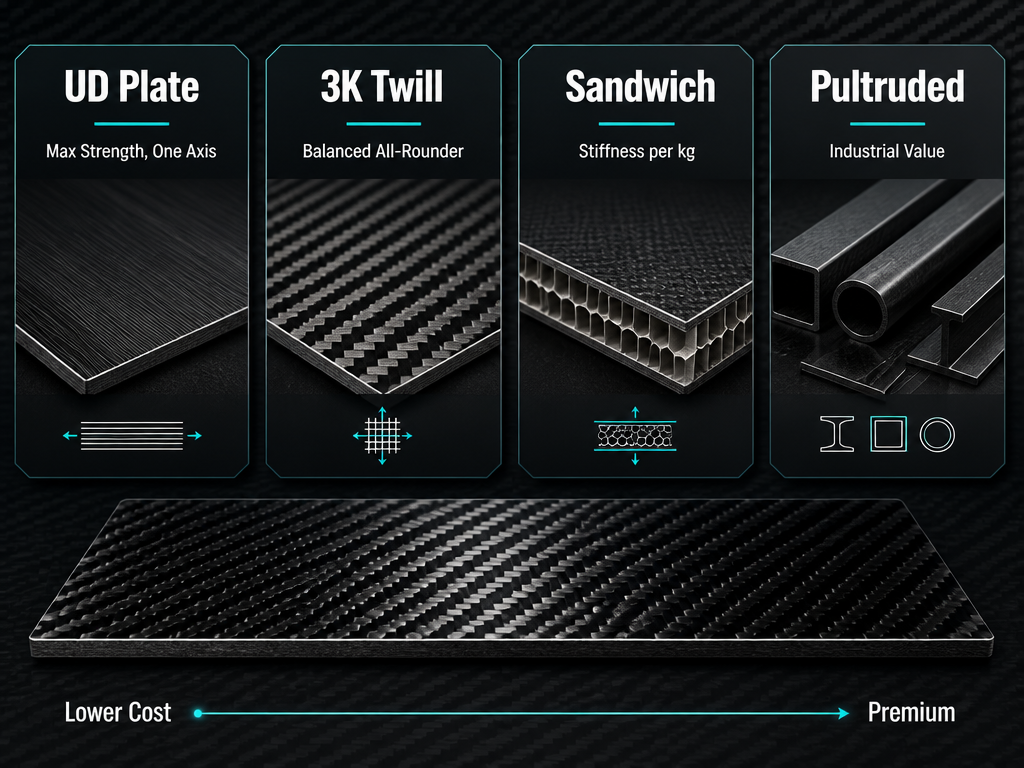
A carbon fiber plate is not simply "carbon fiber in a flat shape." It is a family of engineered products, each with its own internal architecture, manufacturing route, mechanical fingerprint and price. Buyers frequently select a plate by appearance alone — glossy black, nice weave, job done — only to discover the panel is either ten times stiffer than needed or half as strong as the datasheet implied. This guide maps out the real landscape of carbon fiber sheet and plate products so you can specify with confidence, avoid overpaying, and get the flat carbon part your project actually requires.
Every carbon fiber plate is a laminate: layers of carbon fiber reinforcement, bonded by a polymer matrix (typically epoxy), consolidated under heat and pressure. What separates one plate from another is the arrangement of those layers.
Three architectural families dominate the market:
These three architectures, combined with different manufacturing processes and fiber grades, generate the entire product spectrum of carbon fiber board — from hobby-grade sheets a few dollars a piece to aerospace panels that cost more per square meter than a used car.
| Process | Typical Thickness | Fiber Volume | Cost Level | Best For |
|---|---|---|---|---|
| Wet lay-up (hand) | 0.5 – 3 mm | 40 – 50% | Low | Prototypes, one-off cosmetic parts |
| Hot press molding | 0.5 – 8 mm | 55 – 65% | Medium | High-quality flat sheets, precise thickness |
| Autoclave curing | 0.5 – 6 mm | 60 – 68% | High | Aerospace-grade plates, max mechanicals |
| Pultrusion (continuous) | 1 – 50 mm+ | 60 – 70% | Low-Medium | Long plates, constant cross-section, thick sections |
| Vacuum infusion | 1 – 10 mm | 50 – 60% | Medium | Sandwich panels, large areas |
Fiber volume fraction is the number that most buyers never ask about, yet it controls everything. A plate at 45% fiber volume weighs more, flexes more, and costs less than an identical-looking plate at 65% — the mechanical difference is roughly proportional to the fiber content gap. When comparing quotes for a carbon fiber plate, always request the fiber volume fraction, not just the thickness.
Unidirectional plates concentrate every fiber along a single axis, delivering tensile strengths in the region of 2,000–2,500 MPa along that direction — several times what a woven plate of the same weight can manage. They are the workhorse of structural reinforcement: spar caps, stiffening strips, splices, orthotic and prosthetic load paths.
The trade-off is directional behavior: load the plate across the fiber axis and it behaves poorly. For this reason UD carbon fiber sheet is usually supplied with a thin woven surface layer, both to protect the fragile fibers and to give the plate a familiar cosmetic face.
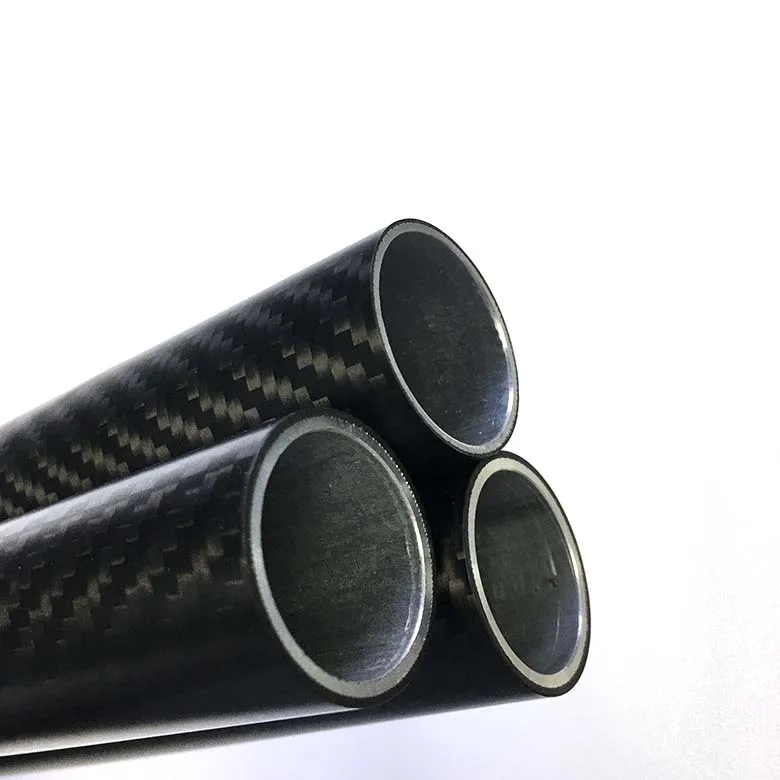
The woven plate is what most people picture when they hear "carbon fiber plate." Layers of 3K twill fabric are stacked and pressed, typically with symmetric lay-ups (0/90, sometimes with ±45 plies), producing an in-plane strength of roughly 600–900 MPa and a modulus of 60–70 GPa — balanced in all directions and visually unmistakable.
This is the default choice for visible structural parts: drone decks and arms, robot chassis plates, camera rigs, race-car interior panels, electronics enclosures. The glossy twill surface doubles as a finish, which is why woven plates so often appear in premium consumer products without any paint.
When a carbon fiber plate must span a large area without bending — tabletops, floor panels, access covers, architectural cladding — solid laminate is the wrong answer. A sandwich construction with a foam or honeycomb core delivers the same bending stiffness at a fraction of the mass. The penalty is edge treatment: cored panels need edge banding or inserts at fastening points.
Continuous pultrusion produces flat carbon fiber plate in unlimited lengths with a perfectly constant cross-section, high fiber volume (60–70%) and tight dimensional tolerance — at a fraction of the cost of press-molded panels of equal thickness. For thick plates (10 mm and above), pultrusion is often the only economically sensible route. Typical uses: heavy-duty machine components, structural frames, conveyor wear strips, tooling and mandrels. If your application is a long, straight, uniform-thickness plate, pultruded carbon fiber board is very likely the most cost-effective specification on this list.
| Property | Carbon Fiber Plate (woven) | Aluminum 6061 | Mild Steel |
|---|---|---|---|
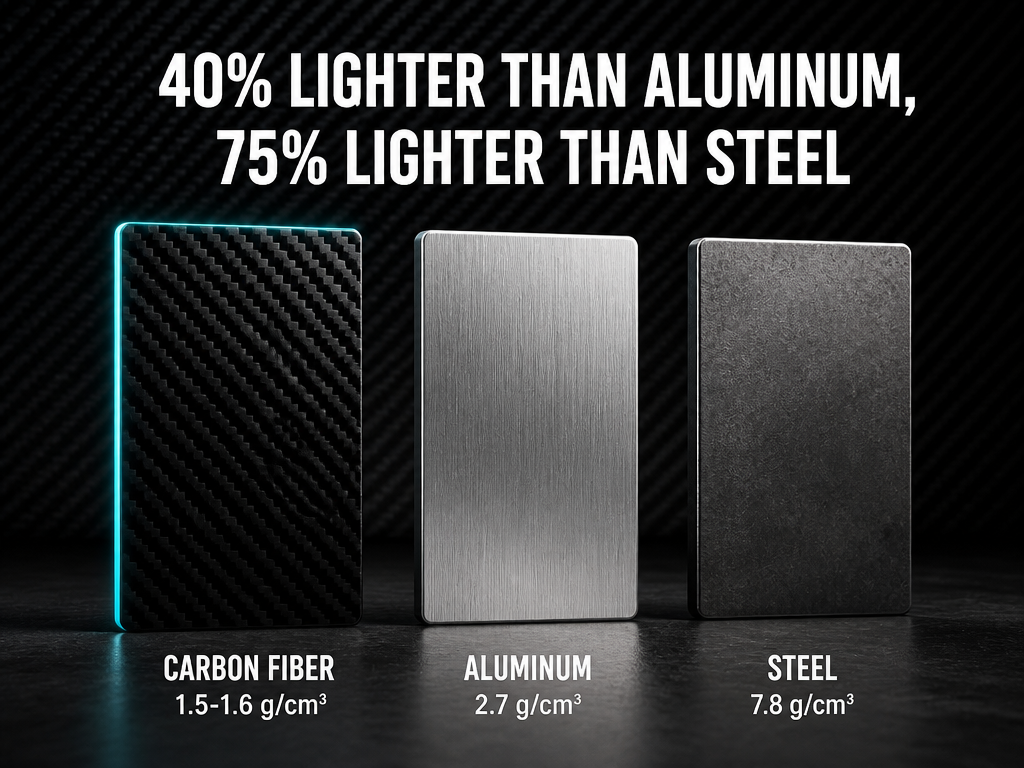
| Density (g/cm³) | 1.5 – 1.6 | 2.7 | 7.8 |
| Tensile Strength (MPa) | 600 – 900 | ~310 | ~400 |
| Tensile Modulus (GPa) | 60 – 70 | 69 | 205 |
| Corrosion Resistance | Excellent | Moderate | Poor |
| Fatigue Behavior | Excellent | Good | Fair |
The comparison that matters is not strength — it is strength per kilogram. A carbon fiber plate is roughly 40% lighter than an equivalent aluminum plate and about 75% lighter than steel, with fatigue endurance that metals cannot match. You pay for that advantage per kilogram, but in weight-critical applications — drones, robotics, medical devices, anything that moves — the payload and energy savings amortize the premium quickly.
Carbon fiber sheet pricing resists simple per-kilogram logic, because the plate price is dominated by architecture, fiber grade, finish and volume — not just raw material. Current global market references (2025–2026) put quality flat sheets in the range of 320 per square meter. At retail, small 3K twill sheets start around $19–55 per piece depending on thickness and size.
Real-world plate quotes move with four variables:
Match the plate architecture to the loading case, not to the aesthetic:
Two specifications are non-negotiable on any purchase order: the fiber volume fraction, and the fiber grade. A plate that hides these two numbers is a plate you cannot design around.
Custom plates are the norm in B2B supply, and the quoting process is straightforward if you come prepared:
At Zhongda Composites, our pultrusion lines produce carbon fiber plate in continuous lengths up to thick industrial sections, and our CNC workshop converts stock plates into finished parts — drilled, profiled and edge-sealed to your drawing. Every plate ships with its fiber grade and fiber volume documented, so your FEA models and production jigs are built on verified numbers, not guesswork.
Send us your drawing, your loading case and your quantity, and our engineering team will return a plate specification — including an honest recommendation when a cheaper architecture will safely do the job. That is the difference between buying carbon fiber sheet, and engineering with it.
Zhongda Composites Co., Ltd. — manufacturer of pultruded and press-molded carbon fiber plate, carbon fiber tube and FRP structural profiles. Contact us for a custom plate quotation and free engineering consultation.
Keywords: carbon fiber plate, carbon fiber sheet, carbon fiber board, UD carbon fiber plate, 3K twill carbon fiber plate, pultruded carbon fiber plate, carbon fiber plate price
 Hot News
2026-10-12
2026-09-25
2026-09-08
2026-09-05
2026-08-10
2026-08-05

 EN
EN