×
×
If you have ever shopped for carbon fiber tube or any carbon fiber component, you have almost certainly stared at a specification sheet listing grades like T300, T700, T700S and T800 — and wondered what the numbers actually mean. They all look like carbon fiber. They all feel light. But the price difference between them can be more than tenfold, and the mechanical performance gap is just as dramatic.
Choosing the wrong grade means either paying a heavy premium for performance you never use, or specifying a material that quietly fails in the field. This guide breaks down what each Toray-designated grade really is, how their properties differ, what they cost in the 2025–2026 market, and — most importantly for engineers and buyers — how to match each grade to the right application, from pultruded carbon fiber tube to aerospace primary structures.
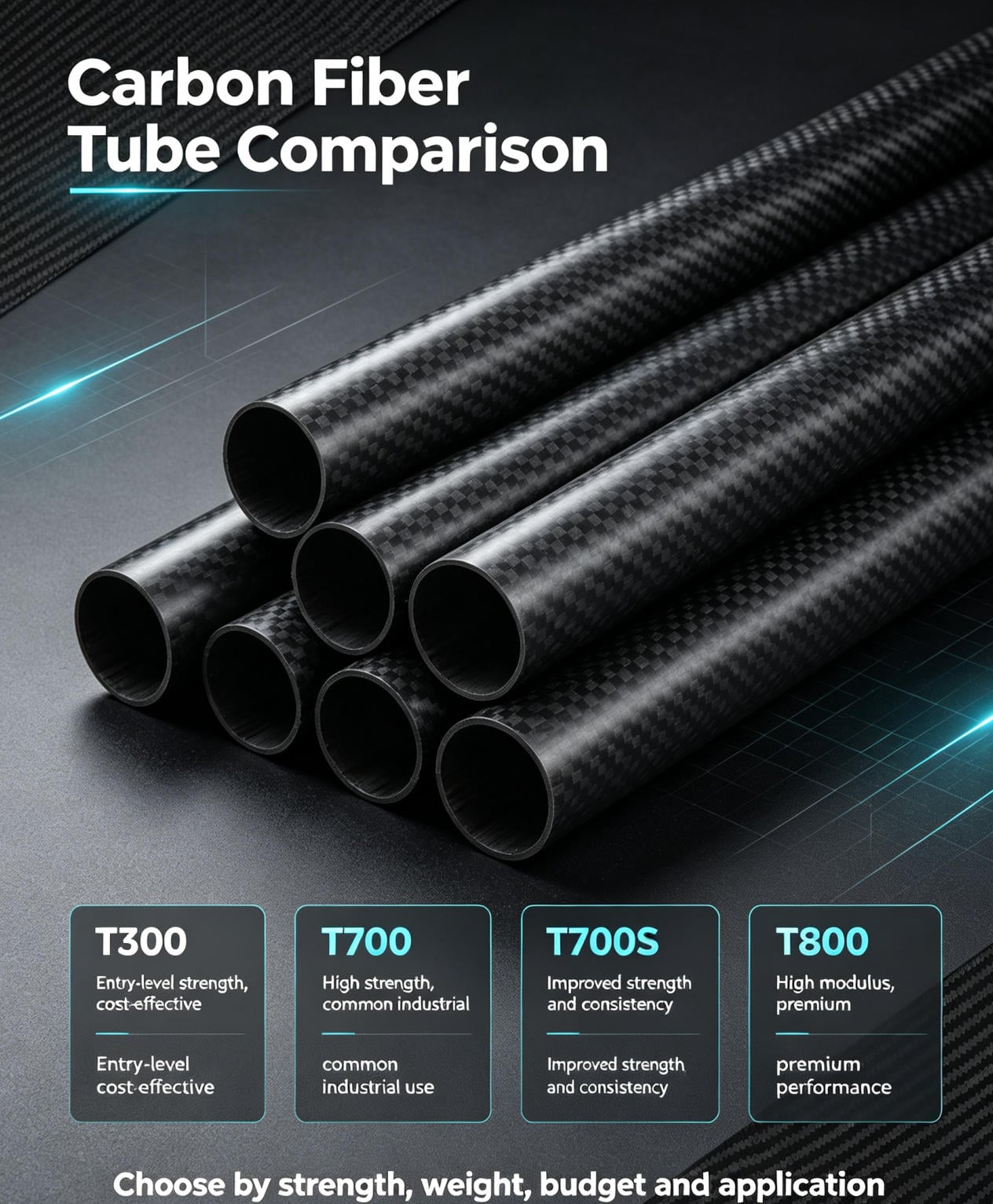
All four grades discussed here are PAN-based carbon fibers produced under the TORAYCA™ naming system, which has become the de facto global benchmark. Domestic and international manufacturers routinely produce "T300-equivalent" or "T700-equivalent" fibers with matching specifications, so the grades function as industry-wide performance tiers.
Two numbers matter above all:
Everything else — price, processing behavior, application suitability — follows from these two parameters.
| Grade | Tensile Strength (MPa) | Tensile Modulus (GPa) | Density (g/cm³) | Typical Tow Sizes | Modulus Class |
|---|---|---|---|---|---|
| T300 | 3,530 | 230 | 1.76 | 1K / 3K / 6K / 12K | Standard |
| T700S | 4,900 | 230 | 1.80 | 6K / 12K / 24K | Standard (high strength) |
| T700G | 4,900 | 240 | 1.80 | 12K | Standard (enhanced) |
| T800H | 5,490 | 294 | 1.81 | 6K / 12K | Intermediate |
| T800S | 5,880 | 294 | 1.80 | 12K / 24K | Intermediate |
Source: Toray TORAYCA™ product data sheets. Note that "T700" in everyday market language usually refers to the T700S industrial standard fiber or its earlier T700SC variant.
In production since 1971, T300 is the original aerospace-qualified carbon fiber and remains the reference point for the entire industry. With a tensile strength of 3,530 MPa and a standard modulus of 230 GPa, it delivers balanced, predictable composite properties with excellent drape and weavability.
Typical applications: non-load-bearing aerospace secondary structures, woven fabrics and prepregs, sports equipment, automotive interior components, fishing rods, and cost-sensitive carbon fiber tube products where extreme strength is not required.
Price position: the entry tier. Small-batch market references in 2025–2026 put T300 at roughly $14–17 per kg, making it the most economical route into carbon fiber for prototyping and general industrial use.
The trade-off: T300 is fine when loads are modest, but its lower strength-to-weight ratio means heavier sections are needed to match T700's load capacity — which often erases the initial material saving.
T700S is the most important grade for industrial buyers today. It keeps the same 230 GPa standard modulus as T300 but jumps to 4,900 MPa tensile strength — roughly 39% stronger — at only a marginal density increase. It is a never-twisted fiber designed for high-throughput processes, and Toray's own documentation lists filament winding and pultrusion among its core applications.
What is the difference between T700 and T700S? Strictly speaking, T700S is the modern industrial-production version of the T700 family. The standard T700 designation historically referred to the aerospace-oriented T700SC/T700S lineage; today the family splits into:
For manufacturers of carbon fiber tube, T700S is the sweet spot: it delivers aerospace-adjacent strength at an industrial price, processes cleanly through pultrusion and roll-wrapping lines, and produces tubes with excellent fatigue resistance for drones, robotics arms, machine frames and sporting shafts.
Price position: small-batch reference prices for genuine Toray T700 12K sit around $34–40 per kg, while domestically produced T700-equivalent fibers are typically lower, and bulk industrial contracts come in well below small-batch levels.
T800 moves into the intermediate modulus class — 294 GPa, about 28% stiffer than the standard-modulus grades — combined with the highest strengths in this comparison. It was developed for weight-critical aircraft structures, and it shows.
The family is split the same way as T700:
Typical applications: aerospace primary structures, defense components, high-end motorsport, drive shafts and torsion tubes, and premium carbon fiber tube for applications demanding maximum stiffness-to-weight — for example, long-span struts, high-speed rotating shafts and racing equipment.
Price position: the step-up is severe. Small-batch references for T800 12K range from 240 per kg. You are paying for tight process control, consistent fiber quality and qualification data — not just raw strength.
| Grade | Indicative Price (USD/kg, small batch) | Cost Logic |
|---|---|---|
| T300 (12K) | 17 | Mature 50-year process, commodity scale |
| T700 / T700S (12K) | 40 | High strength at industrial volumes; import premium for genuine Toray |
| T800 (12K) | 93 | Intermediate modulus, tighter manufacturing tolerances |
| T800 (6K, aerospace) | $240+ | Fine tow, qualification and traceability costs |
Indicative 2025–2026 market reference prices for small batches. Bulk orders — especially 12K/24K industrial tow — are priced significantly lower, and the 2024–2026 capacity expansion in China has pushed industrial-grade prices down sharply.
The engineering rule of thumb is simple: specify the lowest grade that safely carries the load, then add a sensible safety factor.
For anyone sourcing carbon fiber tube, the grade question usually resolves to two choices: T700S for performance-optimized industrial tube, or T300 for cost-optimized general-purpose tube, with T800 reserved for high-end custom work.
At Zhongda Composites, our pultruded carbon fiber tube lines are engineered around T700S tow, which gives the best combination of straightness, surface quality and mechanical consistency for continuous production. For customers who need aerospace-grade stiffness, we can switch the same tooling to T800S fiber — the process is identical, the modulus is not. Every pultruded carbon fiber tube we ship is supplied with fiber grade documented, so your design calculations can rely on real, verified properties rather than marketing numbers.
Whether you need round carbon fiber tube, square tube or fully custom profiles, the right starting point is a load case, not a grade name. Send us your dimensions, loading and environment, and our engineering team will recommend — and honestly tell you when a cheaper grade will do the job.
Zhongda Composites Co., Ltd. — manufacturer of pultruded and roll-wrapped carbon fiber tube, carbon fiber profiles and FRP structural components. Contact us for grade-specific quotations and free engineering consultation.
Keywords: carbon fiber tube, T300, T700, T700S, T800, pultruded carbon fiber tube, carbon fiber price, carbon fiber grade comparison
 Hot News
2026-10-12
2026-09-25
2026-09-08
2026-09-05
2026-08-10
2026-08-05

 EN
EN