×
×
Carbon fiber pultrusion, to be honest, used to be a "high-end" term in our industry. Years ago, when people mentioned pultruded products, they immediately thought of commonplace items like fiberglass door and window frames, cable trays, and grating panels. Carbon fiber? That stuff was too expensive; we couldn't afford it, and we didn't need it.
But after several years in the market, especially in the last two years, I've noticed a complete shift in the landscape. Carbon fiber pultruded products are coming down from their pedestal, quietly making inroads into the most challenging area of civil engineering.
Today, I'll share my perspective as a salesperson on what carbon fiber pultrusion technology has really brought to the table.、
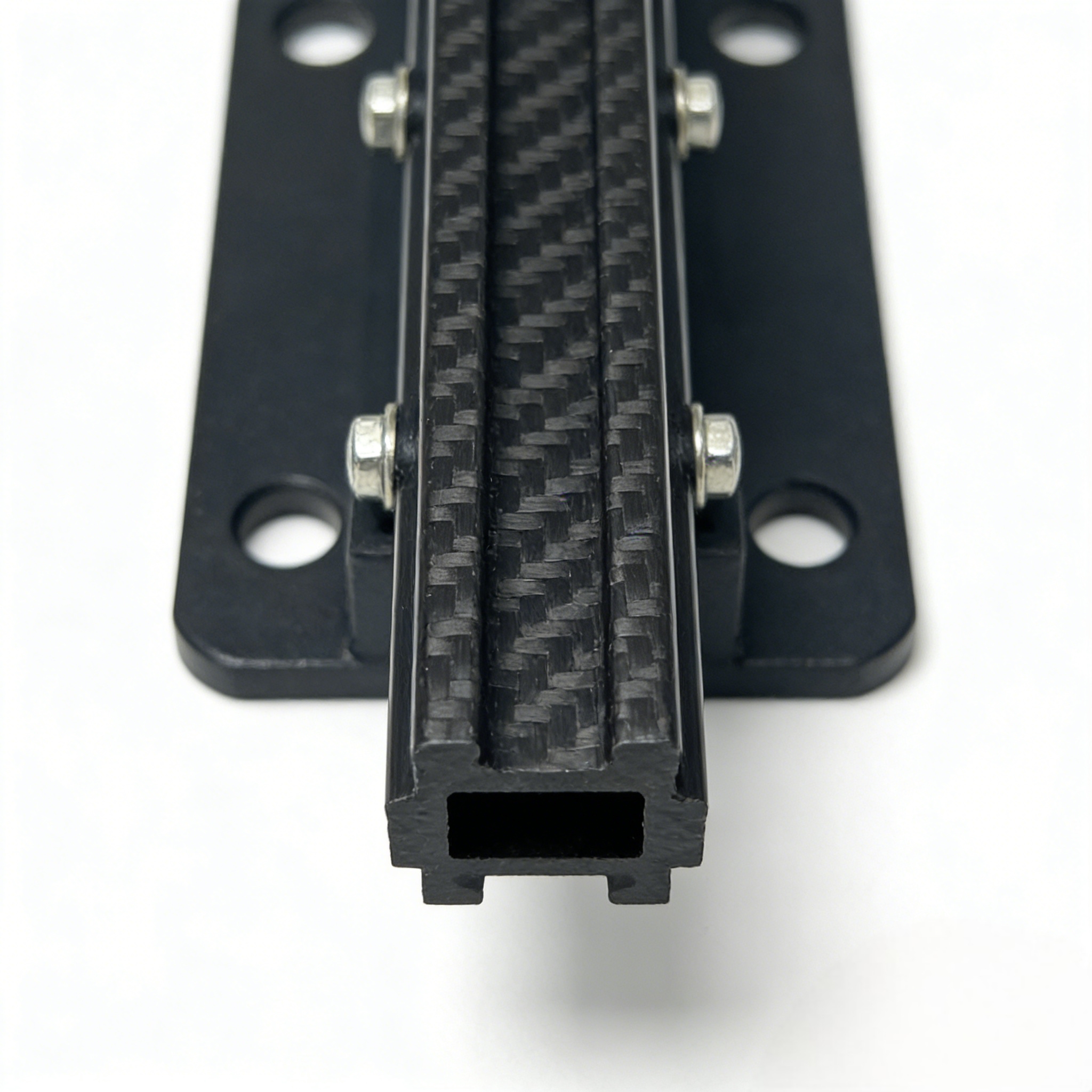
I. From "Steel" to "Carbon": A Tough Battle for Weight Reduction
What do we salespeople fear most from customers? Not the price, but "Why should I use yours?"
The civil engineering industry is incredibly conservative. If you ask a designer to replace reinforced concrete with dark composite materials, their first reaction will definitely be to shake their head. However, in the past two years, a major pain point has become undeniable—steel is too heavy and prone to rusting.
Especially in places like cross-sea bridges, coastal airports, and chemical plants, traditional steel cables and reinforcing bars face two fatal flaws: first, their excessive weight limits the performance of long spans; second, corrosion issues lead to bottomless maintenance costs.
The emergence of carbon fiber pultruded reinforcement precisely addresses this problem.
Take the Qingdao Haikou Road Bridge across the Fenghe River, which caused a stir last year, for example. It was China's first bridge to use large-tow carbon fiber suspension rods. The suspension rods of this bridge used 48K large-tow carbon fiber reinforcement produced through pultrusion.
When I introduce it to clients, my proudest points are two: first, it's lightweight. For suspension rods, carbon fiber weighs only one-fifth or even less than traditional steel cables. Second, it doesn't rust. This is crucial, especially in coastal areas. In Qingdao, the sea breeze causes severe salt spray corrosion, meaning ordinary steel cables need replacing after only a decade or so. Carbon fiber, however, is inherently immune to this.
This isn't just building a bridge; it's buying a "lifetime insurance" policy for it.
II. "Star Projects" in the Construction Industry: From Shanghai to Xiamen
If the Fenghe Bridge set a precedent, the following projects were the real test.
I met some friends from China Construction Eighth Engineering Bureau at an exhibition, and we talked about their Shanghai Midea Global Innovation Park project. That project used large-tow carbon fiber reinforcement, 12mm in diameter, directly as heavy-duty suspension rods. Guess what? Compared to traditional steel suspension rods, steel usage was reduced by 60%, and the weight was halved.
These figures immediately impressed the client. Modern architecture increasingly pursues "large spans" and "landmark" status, but traditional materials are too heavy, limiting designers' imaginations. Carbon fiber pultruded rods are the material that provides that "support."
And then there's Xiamen Xiang'an Airport. The project was located on an island, where the corrosive environment was unimaginable. The engineering team demonstrated the application of carbon fiber tie rods there, with a diameter exceeding 20 millimeters and a measured breaking force exceeding 650 kN. In our industry, this is called "high-strength replacement," directly replacing the original high-strength steel tie rods with carbon fiber rods.
Imagine, in the future, when we take a flight, the massive terminal buildings overhead will be supported by our carbon fiber products; the feeling will definitely be different.
III. Breakthrough in Large Tow: Making "Luxury Materials" More Accessible
Having said so much, some colleagues might ask: "The product is good, but it's ridiculously expensive, how do we promote it?"
This is where the contribution of large tow carbon fiber comes in. Previously, carbon fiber was expensive mainly because it used small tows of 12K (1K represents 1000 monofilaments in a bundle of fiber) and 24K, achieving ultimate performance, but also extreme price. But now, domestic giants like Shanghai Petrochemical and Sinopec Shenying have mastered the use of 48K large tow.
What is the biggest advantage of large tow? Low cost. Although thicker individual filament bundles make resin impregnation more difficult, domestic manufacturers have overcome this challenge by improving the pultrusion process.
Lower costs open up more applications. Materials previously only used in aerospace and Formula 1 racing can now be laid in buildings, embedded in concrete, and even made into longer cables.
Speaking of long cables, there was a milestone last year. Shanghai Petrochemical produced 100-meter-long carbon fiber reinforcing cables, used in the air-supported membrane structure aggregate yard of a highway project. That cable was 92 meters long but weighed only 65 kilograms, 80% lighter than steel cables. Installation didn't require a large crane; a few workers were enough. This was unthinkable before.
IV. Showing Customers the Cost: Not Just Look at the "Face," But the "Substance"
As a salesperson, my ultimate weapon is always showing customers the cost.
"Mr. Wang, don't underestimate the power of my carbon fiber poles, which cost hundreds of thousands per ton, while your steel cables only cost a few thousand. Do the math: using my poles, you can save on all the subsequent anti-corrosion and maintenance costs; you can achieve larger spans with thinner poles, saving both steel and space; your construction site is on a mountaintop, and using my poles will save you a significant portion on transportation and hoisting costs..."
This is the core logic of carbon fiber pultruded products: total life-cycle cost.
Currently, the country is vigorously promoting "dual carbon" (carbon dioxide, carbon fiber, and carbon sequestration), advocating energy conservation and emission reduction. Carbon fiber pultruded profiles are inherently a green material; they reduce structural weight, meaning less energy-intensive materials like cement and steel can be used during construction.
I have a "Global Carbon Fiber Pultruded Profile Industry Trend Analysis Report," which predicts that by 2026, China's domestic production rate will reach 90%. What does this signal? It's the clarion call for domestic substitution, and a turning point for price reductions and explosive application growth.
From Wind River in Qingdao to innovation parks in Shanghai, and then to Xiang'an Airport in Xiamen, carbon fiber pultruded products are making a significant impact on the civil engineering field. Previously, we sold "materials"; now we sell "solutions"—life-extending solutions for bridges, weight-reducing solutions for buildings, and, more importantly, financial solutions for reducing overall costs for our clients.
As a composite materials salesperson, I feel fortunate to be in this era of transformation. Watching those black carbon fiber reinforcements being embedded in reinforced concrete, I'm not just handing out a pole, but also the industry's ambition and future of "overcoming strength with strength."
 Hot News
2026-10-12
2026-09-25
2026-09-08
2026-09-05
2026-08-10
2026-08-05

 EN
EN