EN
EN



OEM&ODM carbon fiber profile
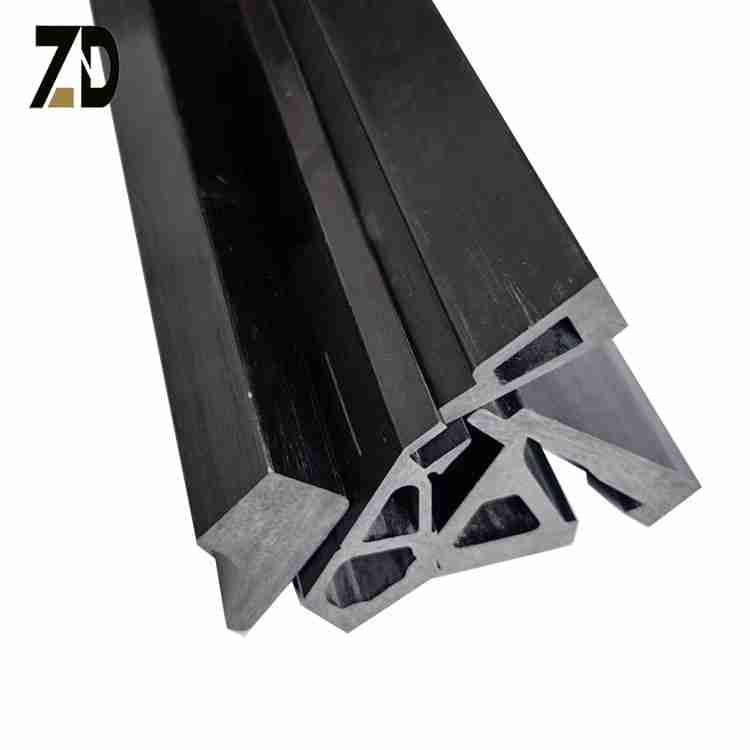
Epoxy high-strength carbon fiber pultrusion process for irregularly shaped products
- Overview
- Recommended Products
Carbon fiber pultrusion (CFPD) profiles are rapidly expanding from traditional applications to high-end, high-value-added sectors. Currently, they are mainly concentrated in four core areas: high-end rail transit, clean energy (wind power), civil engineering and construction, and emerging lightweight structures.
1. High-end Rail Transit: A Frontier of Technological Breakthroughs
This is currently the most cutting-edge application area for CFPD profiles. Manufacturers, represented by CRRC (China Railway Rolling Stock Corporation), have successfully combined large-tow carbon fiber multi-axial warp-woven fabrics with the pultrusion process to manufacture multi-cavity profile beams exceeding 20 meters in length, which have been applied to the main load-bearing structure of the CETROVO high-speed metro. This signifies that the technology has the capability to replace traditional metal materials and bear the main load.
2. Clean Energy (Wind Power): The Main Market for Large-Scale Applications
Wind power is one of the most successful areas for the large-scale commercial application of CFPD. As wind turbine blades develop to exceed 100 meters in length, traditional glass fiber can no longer meet the requirements for stiffness and weight reduction. Carbon fiber main beams (carbon plates) produced using the pultrusion process can be mass-produced at a reasonable cost, effectively solving the problem of blade "self-weight collapse," and have become the standard material for large wind turbine blades of 10MW and above.
3. Civil Engineering and Construction: Leveraging Corrosion Resistance and Construction Advantages
In applications such as bridge reinforcement and harbor terminals, pultruded profiles exhibit significant advantages due to their lightweight, high strength, and excellent corrosion resistance. For example, Toray's pultruded plates are widely used for the reinforcement of concrete structures; their lightweight characteristics allow for construction in confined spaces without the use of heavy machinery.
4. Other Emerging Markets: Flourishing Across Multiple Fields
Notable new growth areas include humanoid robot structural components and low-altitude aircraft/drone parts. These fields have an urgent need for lightweight complex load-bearing structural components, becoming a highly promising blue ocean market for pultruded profiles.
Technological Trends: The next generation of pultrusion technology is evolving from traditional unidirectional reinforcement to quasi-isotropic reinforcement using multi-axial warp-knitted fabrics. This makes it possible to produce more complex and comprehensively stressed irregularly shaped structural components, greatly expanding its application range.