
 EN



Carbon Fiber Square Tube for Drones: Designing a Better Structural Path for Airborne Systems
A drone is often described by its motors, propellers, flight controller and payload. Yet beneath those visible systems is a less obvious engineering problem: how to create a frame that remains light enough to fly, stiff enough to control, and practical enough to assemble and maintain. For many UAV designs, the answer is not another decorative panel or a thicker round tube. It is a more deliberate structural section — the carbon fiber square tube.
A square profile gives engineers something a round tube cannot provide as naturally: defined flat faces for clamps, brackets, fasteners, battery trays, electronics covers and modular frame joints. Combined with the low mass and directional stiffness of carbon fiber, a square tube can become a useful interface between the aerodynamic body of a drone and the equipment it must carry.
This article presents an original application framework for carbon fiber square tube for drones. Instead of treating the material as a generic lightweight pipe, it examines how the section participates in the complete load path: from motor thrust, through the arm and central frame, into the payload, landing gear and serviceable connection points
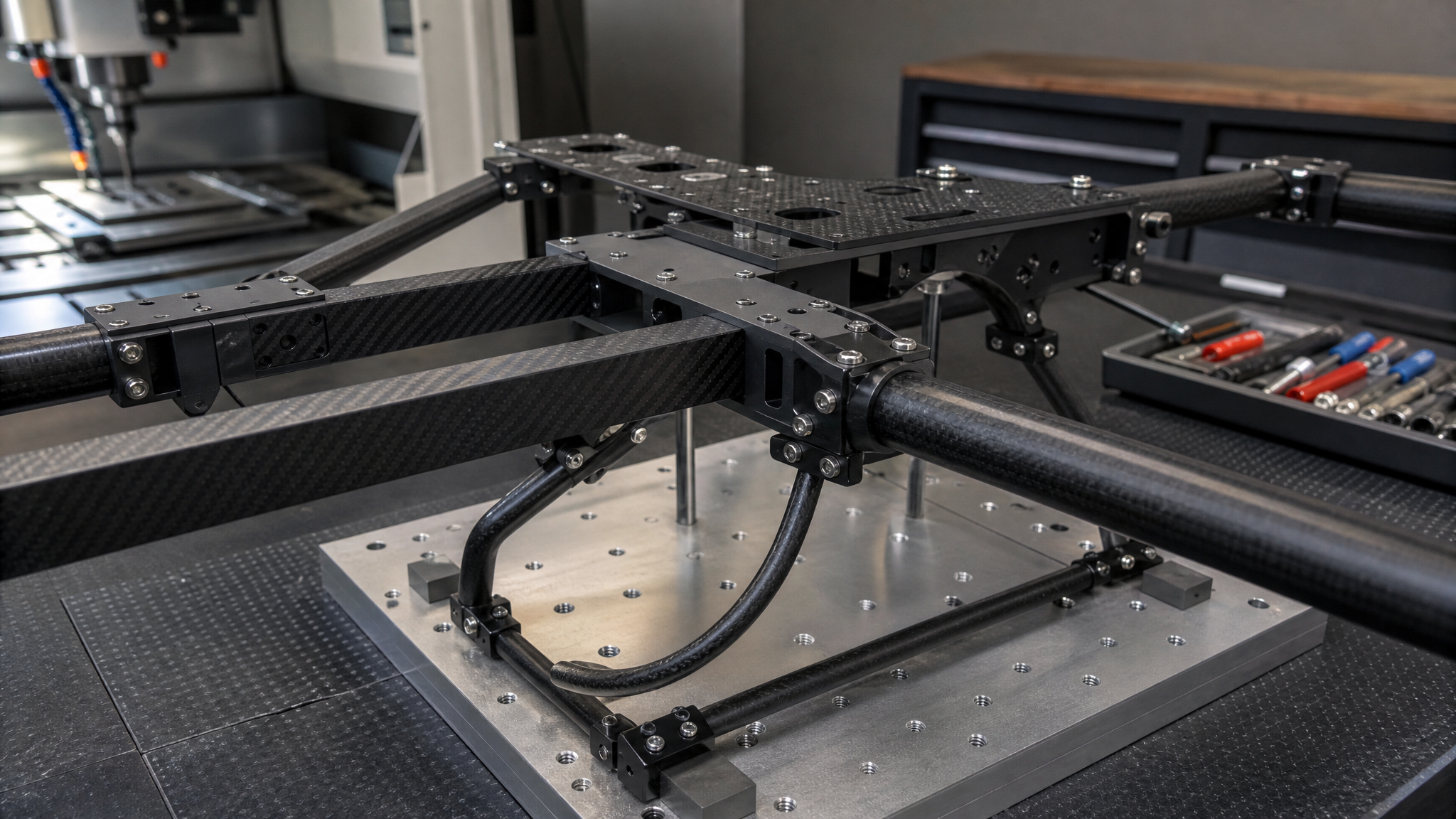
1. The Real Design Problem: A Drone Frame Is a Network of Loads
Every airborne platform contains several simultaneous load cases. Motor thrust introduces bending and vibration at the arms. Propeller rotation creates repeated dynamic excitation. Batteries, cameras, sensors and communication equipment add concentrated weight at specific locations. Landing creates impact through the feet and lower frame. Transport, folding and maintenance introduce additional handling loads that may not appear in a simple flight simulation.
This means that the best structural member is not always the lightest member on a datasheet. It is the member that carries the required load while connecting cleanly to the surrounding parts. A carbon fiber square tube can be valuable because its geometry supports this second requirement.
The four faces of a square section create predictable reference planes. One face can support a motor-arm clamp, another can carry a wiring channel, and a third can connect to an equipment bracket. The result is a frame that is easier to index, align and assemble than a round member that may need anti-rotation features or specially shaped collars.
For OEM drone manufacturers, this interface advantage can reduce the number of custom transition pieces in the assembly. It does not eliminate engineering review: corner radii, wall thickness, bearing areas and fastener loads still require attention. But it gives the design team a more practical starting point for a modular airframe.
2. Carbon Fiber Square Tube Versus Round Tube in UAV Structures
Round carbon fiber tubes remain useful for many drone architectures. They are efficient in bending, familiar to manufacturers and suitable for clamp-based frame designs. A round tube may also be preferred when a boom must rotate freely, when a telescoping mechanism is required, or when the surrounding connector is already designed around a circular interface.
A square carbon fiber tube for drones becomes more attractive when the frame needs built-in orientation and broad mounting faces. The comparison should therefore be made according to the assembly problem rather than by asking which shape is universally stronger.
Flat Faces for Integration
The flat faces of a square tube simplify the attachment of plates, brackets and cable guides. A designer can create a direct contact surface instead of wrapping a clamp around a curved wall. This may help reduce part count and make the assembly easier to inspect.
Resistance to Unwanted Rotation
A square profile naturally provides anti-rotation behaviour when fitted inside a matching connector or supported by a keyed bracket. This can be useful for folding arms, sensor booms and equipment rails that must return to a repeatable orientation after assembly.
More Defined Packaging Space
Drone designers constantly work around batteries, flight controllers, power distribution boards and payload cables. A square section can create a more predictable boundary for adjacent components. It is easier to place a protective cover, spacer or tray against a flat wall than against a continuously curved surface.
Different Corner Behaviour
The benefits of a square section do not remove the need to manage its corners. Sharp external corners may be vulnerable to impact or handling damage, while internal corners can influence stress concentration and tooling. Rounded corners, suitable edge finishing and local reinforcement should be included in the product drawing rather than added after production.
3. Primary Application One: Multirotor Arms and Motor Supports
Multirotor arms transfer motor thrust and vibration into the central frame. They must remain aligned while the aircraft changes attitude, carries payload, or experiences repeated acceleration. A square carbon fiber tube can serve as an arm or an arm core when the motor mount and central connector are designed around its flat faces.
The key benefit is not simply “more strength.” It is controlled assembly. A motor plate can be bonded or bolted to a defined face, while a central joint can use a keyed cavity to establish repeatable orientation. For a production drone, repeatable orientation helps reduce assembly variation and makes replacement easier in the field.
The tube should not be treated as an isolated component. The interface between the motor mount and the tube may create concentrated bearing or crushing loads. If bolts pass through the wall, the local area may require an insert, sleeve, bonded reinforcement or a wider load-spreading washer system. If the tube is clamped externally, the clamp pressure must be controlled so that the wall is not damaged during assembly.
For an electric vertical take-off platform, the design team should review arm length, motor position, payload distribution and the expected vibration environment before selecting the section. A short arm and a long arm can need different stiffness targets even when the external shape appears similar.
4. Primary Application Two: Payload Rails and Equipment Frames
Industrial drones increasingly carry cameras, mapping sensors, inspection instruments, lighting systems, delivery modules or other mission equipment. These payloads rarely load the airframe evenly. They often attach below or forward of the central frame, shifting the centre of gravity and increasing local vibration sensitivity.
A carbon fiber square tube can be used as a payload rail, cross-member or equipment frame. Its flat faces provide useful mounting surfaces for a tray or bracket, while its closed section keeps the structure relatively clean and protected. This is especially useful when the payload must be removed for transport or replaced for a different mission.
A well-designed payload frame should separate three functions:
- Primary support — carries the equipment weight and transfers it into the main airframe.
- Alignment — maintains the sensor or instrument's intended orientation.
- Service access — allows the payload to be removed without dismantling unrelated parts.
The square tube can contribute to all three, but only when the joints are designed as carefully as the tube itself. Avoid placing a heavy payload at the end of a long unsupported member without reviewing deflection and vibration. A lighter tube with a well-positioned support may perform better than a heavier tube used as an unnecessarily long cantilever.
5. Primary Application Three: Battery Trays, Electronics Frames and Protective Cages
Batteries and electronics create a different design challenge. They need protection, ventilation, cable access and quick service, but they should not add unnecessary mass around the centre of the aircraft. Square tubes can form compact frames around battery modules or provide rails to which electronics trays are secured.
The flat outer faces help position straps, clips, covers and anti-vibration mounts. They also make it easier to define keep-out zones for connectors and wiring. Where a battery is installed in a removable cassette, the square profile can provide a locating feature that prevents incorrect insertion or unwanted movement during flight.
For electronics, the carbon fiber material itself must be considered in the system design. Carbon fiber is electrically conductive, so sensitive equipment and antenna arrangements may require insulation, clearance and electromagnetic compatibility review. A carbon fiber square tube should not be promoted as an automatic solution for every electronics enclosure. Its structural value must be balanced with the electrical requirements of the aircraft.
Protective cages and equipment guards are another possible use. A square tube can form a lightweight perimeter or support a cover around a camera, sensor or battery. The cage should be designed to absorb or redirect handling contact without transferring unnecessary impact into the payload.
6. Primary Application Four: Folding Arms and Modular UAV Frames
Transport efficiency is important for inspection, surveying and emergency-response drones. A folding arm can reduce the packed size of the aircraft, but it also introduces a joint that must be aligned, locked and repeatedly operated.
This is where the anti-rotation character of a square carbon fiber tube may support a modular design. The tube can enter a keyed hinge block or slide into a matching receiver. A separate locking pin or clamp can define the deployed position, while the flat faces help maintain orientation between the arm and the central body.
The tube alone does not make a folding mechanism reliable. The hinge, stop, latch, fastener and local reinforcement all participate in the load path. Engineers should evaluate wear at the joint, tolerance accumulation, contamination, operator handling and the possibility of incomplete locking. A production-ready design should make the locked state visually and mechanically clear.
For suppliers, this application creates an opportunity to provide more than a cut length of material. A custom square tube can be delivered with drilled holes, machined ends, bonded inserts, protective sleeves or marked orientation features, provided those requirements are defined in the drawing and validated during sampling.
7. Material Architecture and Manufacturing Choices
The phrase “carbon fiber square tube” describes the external profile, not the complete internal construction. Fiber orientation, resin system, wall thickness, corner radius, surface finish and end treatment all influence the result.
Pultruded Square Tube
Pultrusion is suitable when the square profile remains constant over a continuous length. It can provide efficient production, repeatable dimensions and a high proportion of fibers aligned with the length. This makes it a practical option for straight arms, rails, supports and frame members with predictable load directions.
The design team should still review transverse and torsional requirements. A pultruded section optimized for axial or longitudinal loading may need additional reinforcement or a different architecture if the joint introduces strong crosswise or crushing loads.
Roll-Wrapped or Laminated Square Tube
Roll-wrapped and laminated constructions can provide more flexibility in arranging 0-degree, 90-degree and angled layers. This may be useful when the square tube must manage torsion, local impact, multi-directional loading or demanding surface requirements. The trade-off can include higher tooling complexity, more production steps or a different cost profile.
Local End Reinforcement
Drone structures often fail at interfaces rather than in the middle of a straight member. End inserts, bonded sleeves, internal plugs and external doublers can spread loads around fasteners and reduce local damage. These features should be engineered as part of the component, not assumed to be solved by simply increasing the overall wall thickness.
8. Surface, Edge and Assembly Requirements
A UAV component must survive more than flight. It may be handled outdoors, placed on a vehicle, exposed to dust and moisture, and repeatedly assembled by technicians. Surface quality and edge treatment therefore have operational value.
A smooth satin or clear-coated surface can protect the visible weave and make cleaning easier. Cut ends should be sealed or finished to reduce fiber exposure. Drilled holes should be clean and free from delamination, with dimensions controlled according to the selected fastener or insert.
When carbon fiber is connected to aluminum, stainless steel or other conductive metals, the joint should include an appropriate isolation strategy. Moisture trapped between dissimilar materials can create long-term reliability problems. Washers, sleeves, coatings, sealants and drainage paths should be specified according to the operating environment.
9. How to Specify a Square Carbon Fiber Tube for a Drone Project
A useful inquiry package should contain more than a request for “lightweight carbon tube.” Provide the supplier with:
- External square dimensions and required wall thickness;
- Cut length, quantity and expected annual demand;
- Arm, rail, frame or payload application;
- Main load direction and any known bending or torsional conditions;
- Motor, battery or payload mounting locations;
- Hole patterns, inserts, bonded features and end treatments;
- Required surface finish and weave direction;
- Temperature, moisture, dust, vibration and transport conditions;
- Prototype requirements and target production route;
- 2D drawings, 3D CAD files, samples or clear reference photographs.
If the load case is not fully defined, the supplier should not invent a performance guarantee. A responsible engineering review can instead identify the missing information and recommend a prototype test plan. This is particularly important when the tube is part of a flight-critical structure.
Conclusion: The Square Section as a UAV Interface Strategy
The value of a carbon fiber square tube in drone engineering is not limited to its low mass. Its real contribution is the way its geometry organizes the airframe. Flat faces support direct mounting. Defined corners help control orientation. A closed section creates a clean structural boundary. Custom ends and local reinforcement can connect the tube to the rest of the aircraft without relying on oversized adapters.
For multirotor arms, payload rails, battery frames, protective cages and folding UAV structures, the right square tube can turn a difficult assembly problem into a more deliberate and serviceable design. The final specification should still be based on the real load path, joint design, environment and production volume — not on the profile name alone.