Design Flexibility and Manufacturing Precision
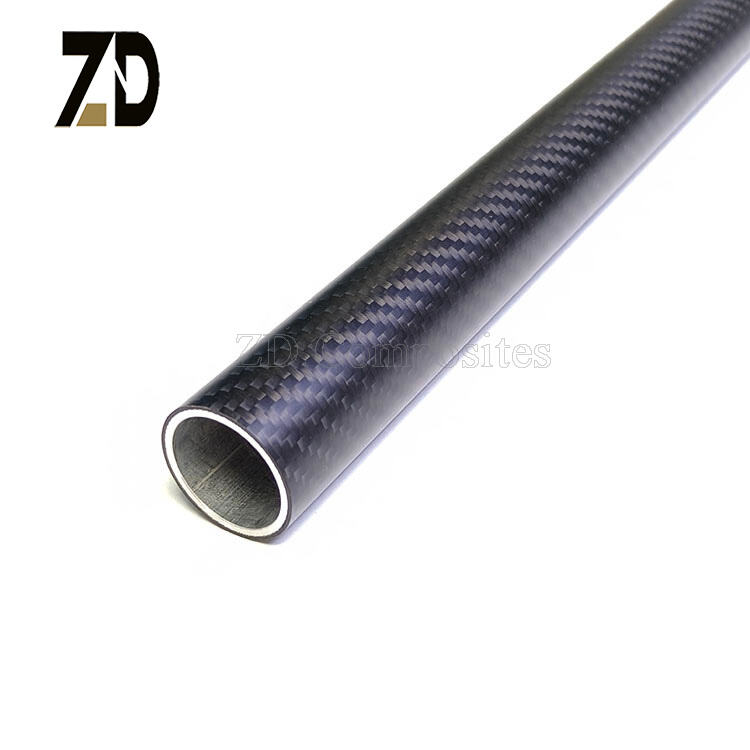
Long carbon fiber tubes offer unprecedented design flexibility and manufacturing precision that enable engineers to create optimized solutions for complex applications that would be impossible or prohibitively expensive with traditional materials. The manufacturing processes, including filament winding, pultrusion, and hand layup techniques, allow for precise control over fiber orientation, wall thickness variation, and geometric complexity while maintaining consistent quality throughout the production run. Filament winding technology enables the creation of long carbon fiber tubes with varying wall thickness profiles, integrated reinforcement zones, and complex end fittings that eliminate the need for secondary machining operations or mechanical joints. The ability to orient carbon fibers in specific directions allows engineers to tailor mechanical properties to match loading requirements, creating structures that are optimized for bending, torsion, compression, or tension loads. Multi-axis winding capabilities enable the production of long carbon fiber tubes with balanced properties that can handle complex loading scenarios while maintaining structural efficiency. Design optimization software allows engineers to analyze fiber orientations and predict performance characteristics before manufacturing, reducing development time and ensuring optimal material utilization. The manufacturing precision achievable with modern production equipment ensures that dimensional tolerances remain within tight specifications even for very long tubes, eliminating the need for post-production machining that could compromise structural integrity. Advanced tooling systems maintain precise control over fiber tension, resin content, and curing parameters throughout the manufacturing process, ensuring consistent quality and performance characteristics. The ability to integrate functional features during manufacturing, such as mounting brackets, sensor ports, and connection interfaces, reduces assembly complexity and eliminates potential failure points associated with mechanical joints. Custom formulations of resin systems allow manufacturers to optimize properties such as fire resistance, electrical conductivity, thermal management, and chemical compatibility for specific applications. Quality control measures include real-time monitoring of manufacturing parameters, non-destructive testing methods, and statistical process control that ensures each long carbon fiber tube meets specified requirements. The design flexibility extends to surface finishes, with options ranging from smooth cosmetic surfaces to textured gripping surfaces or specialized coatings for enhanced performance. Manufacturing scalability allows for efficient production of both prototype quantities and high-volume manufacturing runs while maintaining consistent quality standards. The precision manufacturing capabilities enable the production of long carbon fiber tubes with complex internal geometries, variable cross-sections, and integrated reinforcement features that would be impossible to achieve with conventional manufacturing methods.
 ×
×

 EN
EN